Published September 28, 2026 · RetroForge Supply Team
Inside a Retro Cartridge Factory: SMT Line, ESD Control, and Hand Assembly
Almost nobody who buys retro cartridges has stood on the floor where they get made. Buyers see a price, a photo of a finished cart, and a delivery date. Everything in between stays invisible until something goes wrong.
So here is the in-between. These are photographs taken on our Shenzhen line on an ordinary working day, and this is what each station is doing to your order.
The floor tells you more than the machine list
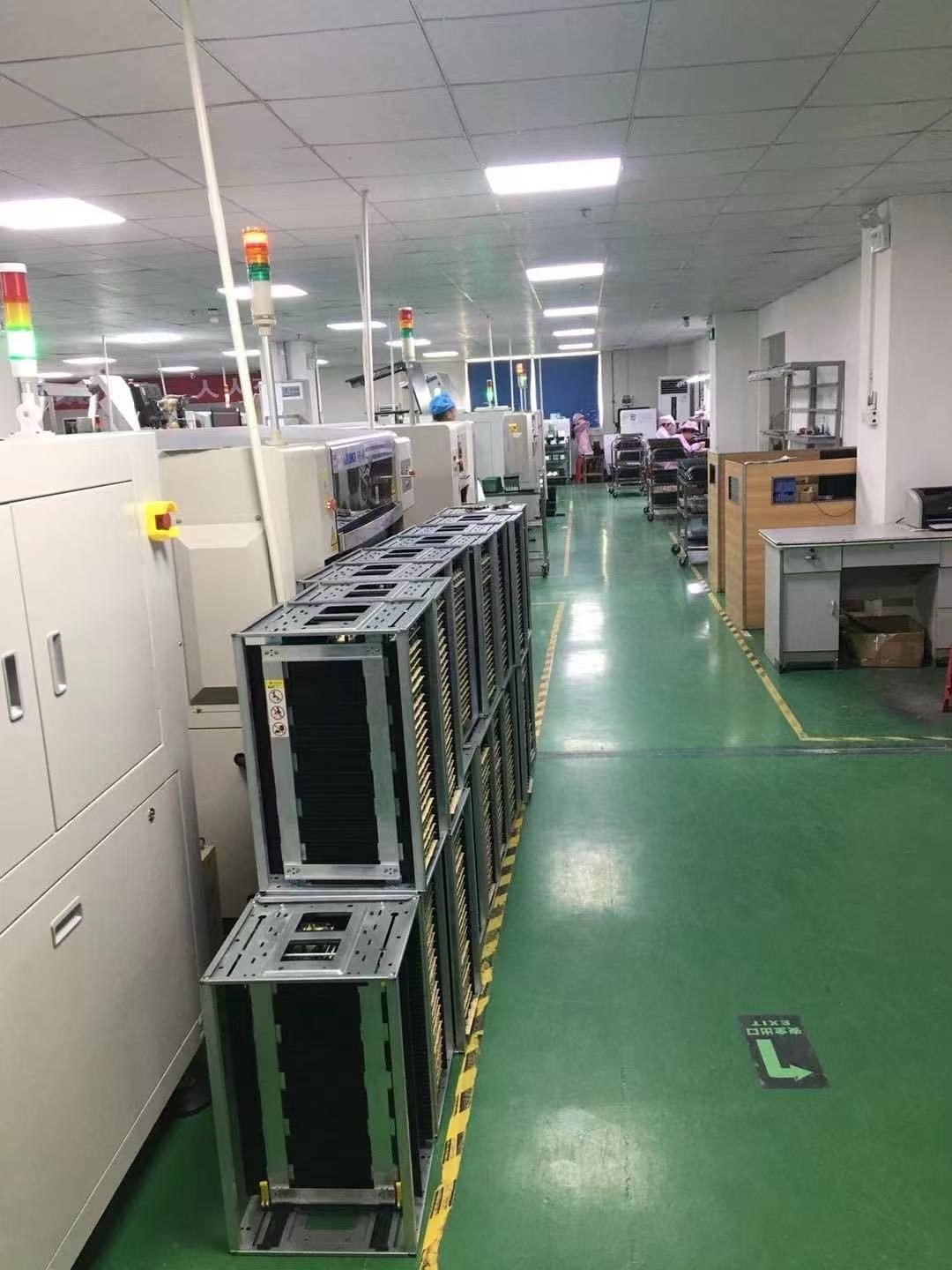
Walk in and the first thing you register is not the equipment. It is the floor: green epoxy, yellow lane markings, arrows painted to keep foot traffic out of the working aisles. Feeder carts and material trolleys are parked inside the lines. Nobody leaves them in the walkway.
That is not tidiness for its own sake. A placement machine's worst enemies in this business are static and dust, and a workshop where people sit, stand, walk and drag plastic trays all day generates plenty of both. Conductive flooring gives the charge somewhere to go before it reaches an IC. The lane markings exist because a trolley bumped into a machine mid-run is an expensive kind of accident.
You can learn a lot about a supplier from this one detail. Ask for a photograph of their production floor. If it is a stock image, or if the aisles are full of half-finished work, that tells you how the rest of the process is probably run.
The SMT hall. Feeder banks stay inside the yellow lines; the aisle stays clear. Signal towers on top of each machine show its state from across the room.
Where the board actually gets built
At the far end of that aisle you reach the placement line. Solder paste goes on first through a stencil, then the machine places components, then the board runs through reflow and comes out with everything soldered down.
Every machine carries a stack light on top: green for running, amber for a warning, red for stopped. From thirty metres away the shift leader can see whether the line is healthy. If you ever get a video walkthrough from a factory and those lights are a wall of red and amber, ask why.
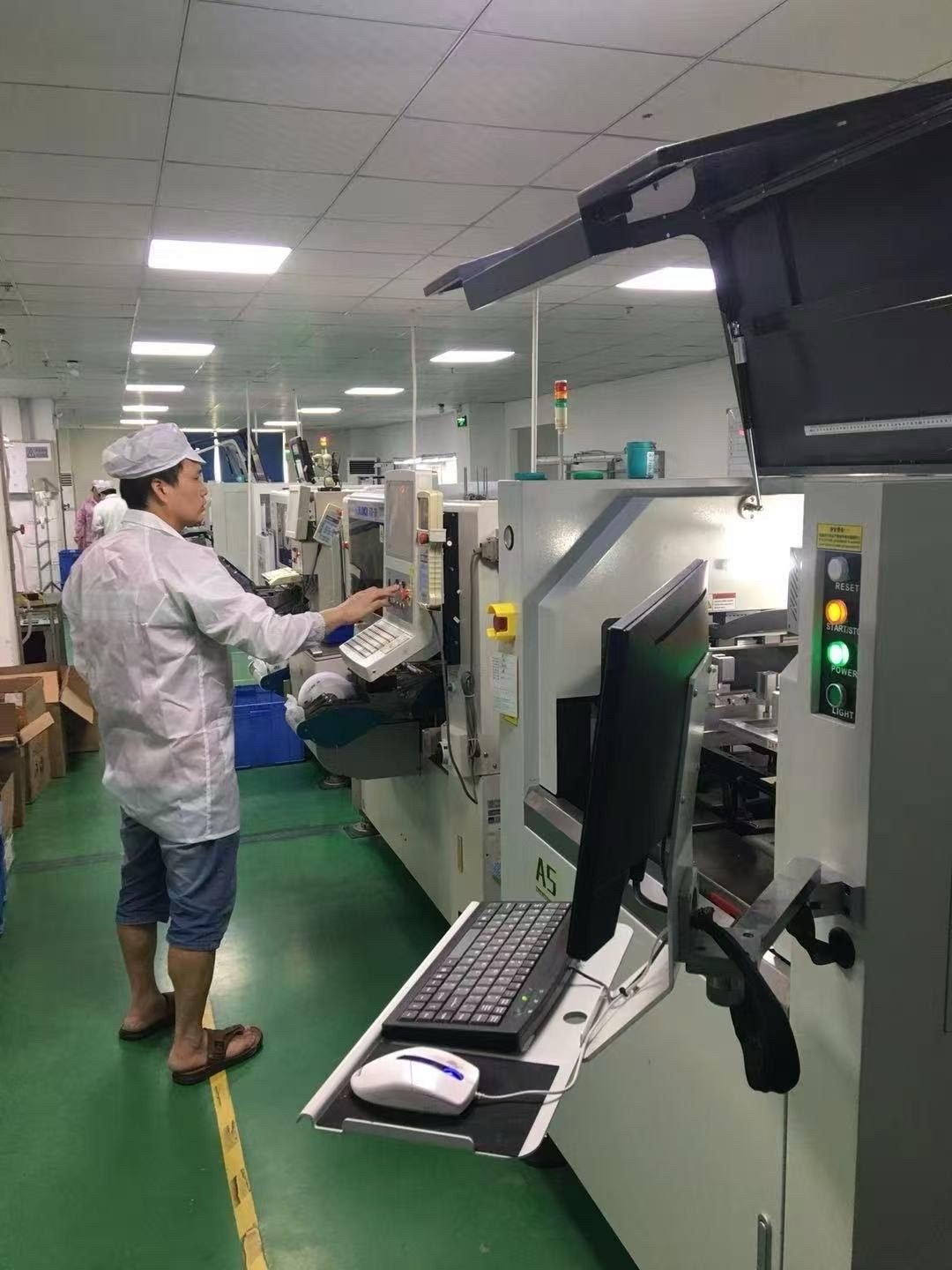
Placement is fast, but it is not unattended. One operator stays at the console through the run, watching the program, checking the board that comes off the reflow oven, and stopping the machine when something looks off. Our cartridge work runs in batches of anywhere from fifty to a few thousand pieces, which means the line changes over constantly. Every changeover gets a fresh stencil check and a first-article board that is inspected before the rest of the run is allowed to continue.
Placement operator at the console. The panel that comes out of reflow is checked by hand before the run continues.
The part machines still can't do
Here is the thing nobody mentions in the factory brochures: the placement machine can put a chip on a board to within a fraction of a millimetre, and it still cannot assemble a cartridge.
Seating a finished board into a shell is a feel job. You are pushing a PCB past mounting bosses, lining up an edge connector so it sits square in the mouth of the shell, and getting the label centred on the front without a wrinkle. Force it and you crack a boss or bend a contact. Do it too gently and the board rattles, and the customer notices on the first insertion.
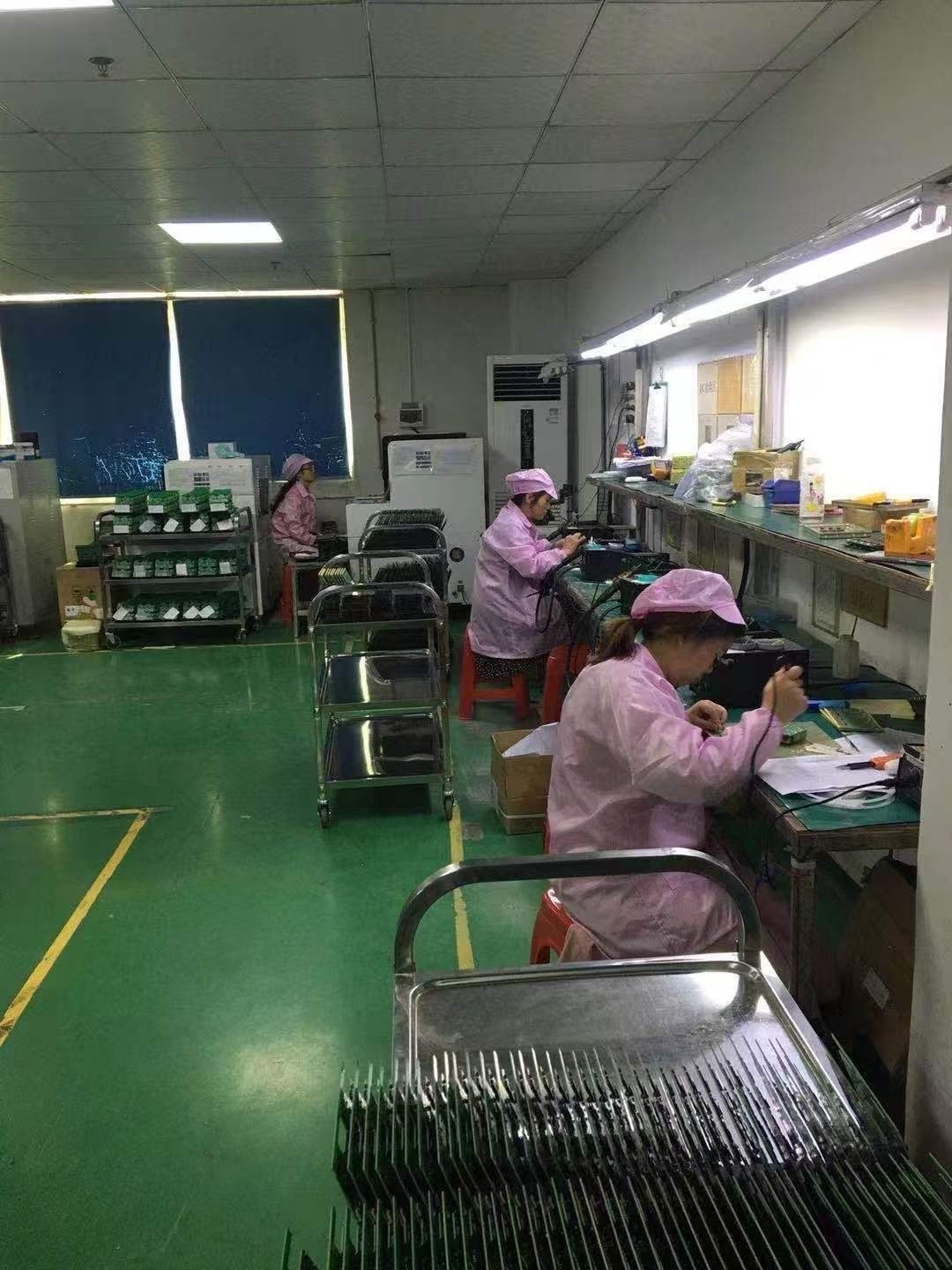
So after inspection the boards go to the assembly benches, where the work is done by hand under task lighting, by operators in ESD smocks and caps, with their trays of parts and their carts of finished boards moving between stations. Gloves on, wrist straps grounded, boards handled by the edges. It looks less impressive than a machine line and it is where most of the quality is actually decided.
The assembly benches. Board into shell, connector squared, label aligned, then on to the test bench.
Inspection is not a separate department
Before any board reaches those benches it passes through optical inspection, which photographs the solder joints and compares them against a known-good reference. That station gets its own article, because it is the single most misunderstood step in cartridge manufacturing. Short version: it catches joint defects that eyes miss at production speed, and it catches nothing at all if the program it runs was never properly built. More on that in how AOI inspection works.
After assembly there is one more gate: every cartridge is powered up and tested. Not sampled. Every one. If you want to know what that test covers, it is on our process and quality page.
What we control, and what we don't
We buy flash memory, we do not fabricate it. So we qualify it instead. Incoming materials get checked against the supplier lot and the date code, because counterfeit and recycled flash is the single most common cause of cartridges that arrive dead, and no amount of good soldering saves a board built around a bad die.
Same with shells. There is a range of quality in reproduction shells, from mouldings that fit cleanly to ones where the screw posts strip on the second assembly. We keep a fixed set of moulds we have used for years rather than shopping around on price each time, because the price difference between a good shell and a bad one is a few cents and the difference in returns is not.
What we do control is everything that happens between those two points. That is the part a factory can be judged on, and it is the part we are happy to show.
Four things to ask for before you place an order
You do not need to fly to Shenzhen to verify a supplier. You do need to ask for specific things, because vague questions get vague answers.
A video walkthrough of your actual run, filmed on a phone, not the edited factory film on their homepage. If they cannot show you your own boards, they are either outsourcing or stalling.
First-article photographs. Board populated, shell assembled, label applied. This is the moment to catch a wrong label colour or a reversed shell, while it costs nothing to fix.
Panel photos before depaneling. This is where you see how the boards were laid out and whether the solder looks even across the whole panel, not just the one board they photographed for you.
A cold sample from the first batch. Ten units shipped to you before the rest of the order goes out, so you can insert them into real hardware yourself. Your hands on a cartridge find things a test rig does not.
All four are free. Ask on the RFQ and they are part of the order, not an extra service. If a supplier charges you for the privilege of seeing your own product, that is worth knowing before you pay a deposit.
Questions we get about the line
Can I visit the factory in person?
With notice, yes, and we will arrange the paperwork. In practice a video call is what most buyers do. It is faster, it can happen before you commit to anything, and you can ask to see a specific machine rather than being walked past the tidiest corner of the building.
Is my order run on the same line as everyone else's?
The line is shared because that is how contract manufacturing works. Your PCB is not. Your panel is laid out for your board, your placement program is written for your component set, and your first-article board is approved before your run continues. Nothing of yours is mixed onto a panel with another customer's product.
Do small orders get the same line as big ones?
Same line, same stations, same inspection. The difference is changeover time. A fifty-piece run spends proportionally longer being set up, which is one of the real reasons small batches cost more per unit. It is not a different quality of production.
How long does a run take?
Assembly and test are rarely the bottleneck. Shell moulding, custom labels and printed boxes are. That is why our lead-time answers always start with the packaging question rather than the cartridge count. If you are working to a launch date, send us the packaging plan early even if the ROM is still being finished.
If you want pricing for a specific platform and quantity, the fastest route is a quote request with your platform, quantity and packaging plan. We reply within one business day. For an overview of what we build, start with wholesale retro cartridges or the custom manufacturing page.
Tell us what you need — we price it in one business day.
Send your platform, quantity and packaging plan through the form. If you would rather talk it through first, message us on WhatsApp with a photo of what you have in mind. Minimum order is 50 units per project.