Published September 28, 2026 · RetroForge Supply Team
AOI Inspection on Cartridge PCBs: What the Machine Sees Before Assembly
"Do you use AOI?" is a question buyers have learned to ask. It is a good question with an unhelpful answer, because every factory will say yes and almost none of them will tell you what their AOI program actually checks.
So here is ours, from the inside. This is the screen at our optical inspection station, what the numbers on it mean, and what it still cannot catch.
First, the shape of the thing
A cartridge board is not manufactured one at a time. Boards are laid out in a panel, usually four or six up, with a narrow frame around them. Panels are what goes through the placement machine, through reflow, and through inspection, because handling one small board at a time is slower and more likely to damage something than moving a rigid panel with a frame to grip.
That matters for inspection. When the camera moves across a panel, it is checking every board on it at once. If a solder problem is caused by something systematic, a paste stencil that was slightly off or a placement head running hot, all four boards usually show it. Inspecting one board and shipping the panel would miss exactly the kind of failure that matters most.
What AOI is actually doing
The machine sits inline after reflow. A camera runs over the panel under controlled lighting and captures an image of every joint. Then it compares what it sees against a reference: a program built from a known-good board, where a human has already marked where each joint should be, how much solder should be there, and which way each component should face.
The program handles the boring questions extremely well, and boring is the point:
Is the joint there at all? Missing solder, insufficient solder, a component that shifted during reflow.
Is there too much? Bridging between pins, a solder ball rolling onto a neighbouring pad. On fine-pitch ICs this is the defect that kills boards in the field rather than on the bench.
Is it the right part, the right way round? Wrong component, reversed polarity, a missing pin-one marker.
Is it in the right place? Offset beyond tolerance, tombstoning on passives, a lifted lead.
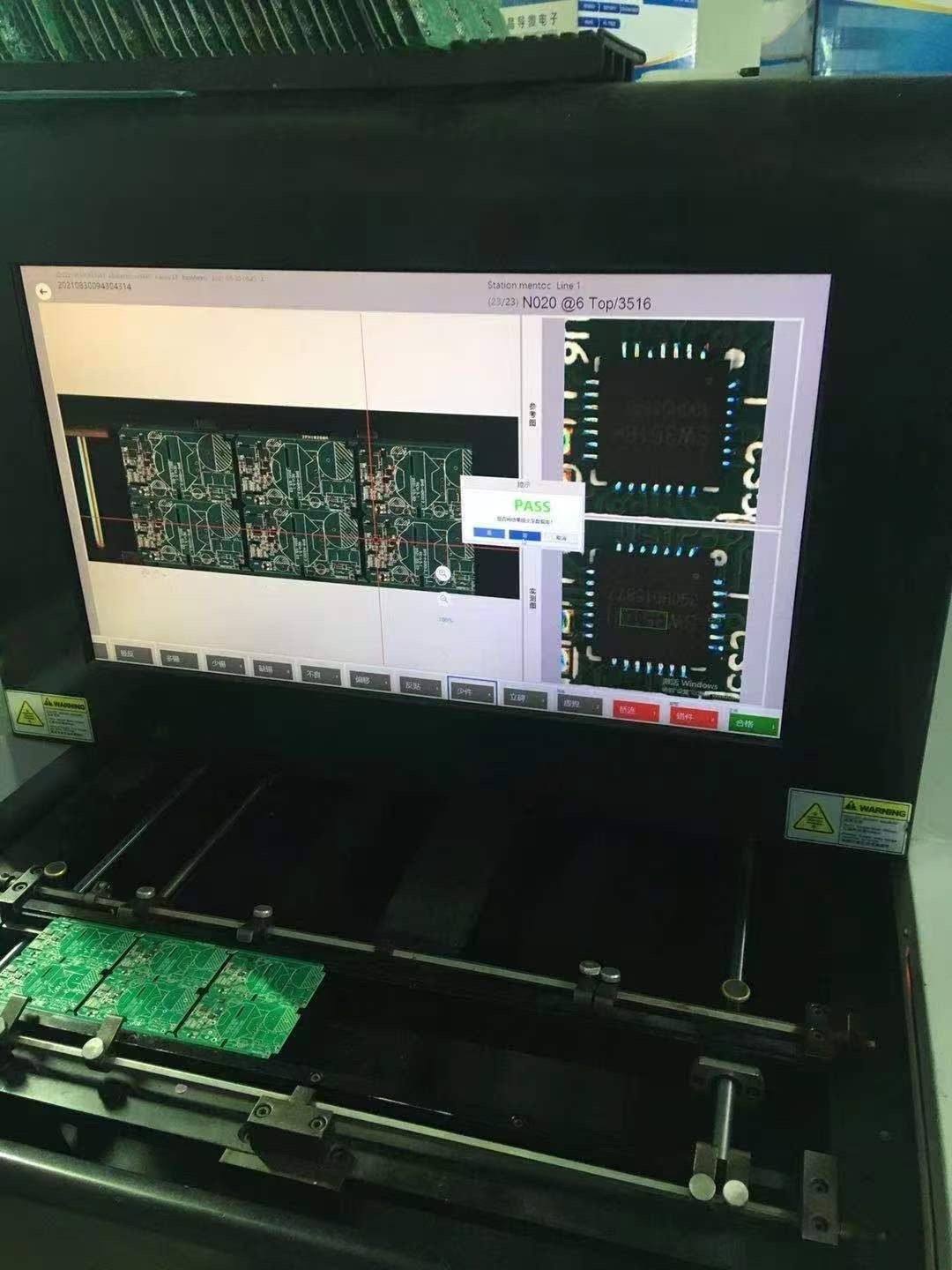
The screen in the photograph covers a four-up panel. The point count in the corner is the number of individual locations the program is checking on that side of that board, and it runs into the thousands. Every one of those is a decision the machine makes in a fraction of a second, on every panel, for the whole run. This is the honest reason AOI exists: not because it is smarter than a person, but because it never gets tired at four in the afternoon.
The AOI station after reflow. Left: the four-up panel as imaged. Right: magnified views of individual joints. The green dialog is a pass on this board, not a pass on the order.
What "PASS" does not mean
This is where most buyers get the wrong idea, so it is worth being blunt. A green PASS means the machine found no joint defect it knows how to look for. It is a statement about solder, and only about solder.
A board can pass AOI perfectly and still be a dead cartridge. Nothing about the solder tells you whether the flash chip inside that immaculate package is genuine, or empty, or programmed with the wrong build. Optical inspection is looking at the outside of things.
What AOI cannot see
Four failure modes walk straight past it.
Programming. An unprogrammed or corruptly programmed chip looks identical to a good one. This is why our process flashes and then reads the chip back, comparing it byte for byte against the source ROM before the board is allowed to carry on down the line. Programming without verification is how you end up with a box of cartridges that all pass every visual check and none of which boot.
Counterfeit or recycled flash. A remarked die in a correct-looking package is indistinguishable to a camera. You catch this at incoming inspection or not at all.
Joints hidden underneath. AOI looks at the surface. Where a joint is under a package body rather than visible at the edge, or where a ball has not actually collapsed, optical inspection has limited information to work with. X-ray is the tool for that, and it is not standard on a cartridge line.
Marginal joints that will fail later. A joint that is present, wetted and correctly shaped but weak can photograph perfectly. It fails after two hundred insertions in a customer's console. No inspection station catches this reliably. The defence is process control at the front end, not inspection at the back.
So AOI is one layer, not the whole system. In our workflow it sits between the SMT line and hand assembly, alongside incoming material checks, program-then-verify flashing, and 100% functional test on real hardware before anything is packed.
Why the layering matters to your defect rate
Different checks catch different things and none of them overlap much. Material checking catches bad chips before they are soldered. AOI catches solder defects before assembly and before the cost of a shell, a label and a box gets added to a board that was never going to work. Program verification catches the failures AOI is blind to. Functional test catches the ones that got past all three.
Remove any one of them and the defect does not disappear. It just moves later in the process, which means it costs more to fix, or it moves all the way to your customer, which is worse.
Three questions to ask a supplier about their AOI
Skip "do you have AOI". Ask these instead and listen to whether the answer is specific.
Does it run on 100% of the boards or on a sample? Inline AOI on a cartridge panel should cover every board, every panel. A sampled AOI program is mostly a marketing answer.
Who wrote the program, and how often is it revalidated? The machine is only as good as its reference. If a supplier cannot say when their AOI program was last checked against a known-good board, the machine is running on assumptions.
What happens to a failed board? The right answer involves a defined path: rework by a trained operator where the defect is reworkable, scrap where it is not, and a record of what failed. "We fix it" is not a process.
One more, and this is the question that separates a real inspection step from a photo opportunity: can I see the AOI report for my order? If the station is genuinely running on your boards, the data exists.
Questions we get about inspection
Is AOI better than visual inspection by an operator?
It is better at different things. AOI is more consistent and does not lose concentration over an eight-hour shift, which is what matters on a long run. A trained operator is better at judging a joint that is unusual rather than wrong, and at spotting a defect nobody wrote into the program. Most factories that run AOI properly still have a person looking at the boards.
Does every order get AOI, even a fifty-piece run?
Yes. The setup cost of the program is the same whether you order fifty units or five thousand, which is part of why small batches carry a higher unit cost. It is not skipped to save you money.
Can AOI catch a wrong label or a wrong shell?
No. Optical inspection happens while boards are still in the panel, before shells and labels exist. That end of the product is covered by first-article approval and final functional test. If a supplier claims their AOI station validates finished cartridges, they are describing a different machine.
Tell us what you need — we price it in one business day.
Send your platform, quantity and packaging plan through the form. If you would rather talk it through first, message us on WhatsApp with a photo of what you have in mind. Minimum order is 50 units per project.